
Overview
- Why AIS 140 Compliance Matters
- Compliance Challenges for Fleets
- AIS 140: Who Must Follow It?
- The 7 Steps
- Common Mistakes to Avoid
- How Transight Makes Compliance Easy
- Turning Compliance into Advantage
Why AIS 140 Compliance Matters
In India, road transport plays a pivotal role in the economy, but safety and accountability remain pressing concerns. The Automotive Industry Standard (AIS) 140, mandated by the Ministry of Road Transport and Highways (MoRTH), addresses this by making GPS tracking devices and emergency buttons mandatory in commercial vehicles.
For fleet operators, the issue isn’t just about regulation—it’s about avoiding penalties, downtime, and operational delays due to non-compliance. This article provides a step-by-step AIS 140 compliance checklist to help you meet requirements smoothly and avoid costly mistakes.
Compliance Challenges for Fleets
While AIS 140 is designed to improve passenger safety and fleet transparency, many fleet owners struggle with:
- Choosing the right government-certified GPS devices
- Handling the installation costs and downtime
- Managing data connectivity in low-signal areas
- Understanding the paperwork and certification process
Without a clear roadmap, compliance can feel like an uphill battle.
AIS 140: Who Must Follow It?
AIS 140 is a standard mandated for all:
- Public transport vehicles (buses, taxis, cabs, school buses)
- Commercial goods carriers
- Emergency response vehicles (ambulances, fire trucks)
The regulation requires vehicles to be equipped with:
- Government-approved GPS tracking units
- Emergency panic buttons
- Data transmission to state transport monitoring centers
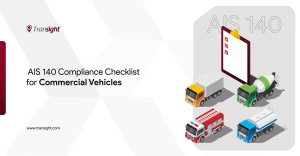
The 7 Steps
Step 1: Install Government-Approved GPS Devices
Requirement: Only devices certified by ARAI/ICAT under AIS 140 standards are permitted.
Issue: Many cheap, uncertified devices are available in the market, which can lead to rejection by transport authorities.
Solution: Fleet operators should verify certifications and partner with trusted IoT providers like Transight Systems for genuine devices.
Step 2: Enable Real-Time Vehicle Tracking
Requirement: Continuous real-time tracking must be possible.
Issue: Poor connectivity in remote areas often breaks location updates.
Solution: Look for devices with 2G/4G dual connectivity and alternative positioning methods (cell tower triangulation, EPO/AGNSS) to ensure uninterrupted tracking.
Step 3: Panic Button Integration for Safety
Requirement: At least one emergency panic button must be installed for passengers/driver safety.
Issue: Many operators skip this to reduce costs, risking penalties.
Solution: Ensure panic buttons are hardwired and tested for proper integration with the GPS unit.
Step 4: Data Storage & Transmission Standards
Requirement: Devices should store and transmit data packets (location, speed, ignition, emergency events) to central servers.
Issue: If history packets are not stored properly, operators may face compliance issues.
Solution: Choose GPS units with large memory capacity and smart history packet storage.
Step 5: Ensure SIM Connectivity (2G/4G Compliance)
Requirement: Devices must support GSM/GPRS/4G networks for communication.
Issue: Many older devices work only on 2G, which faces a gradual shutdown in many regions.
Solution: Invest in future-proof 4G-enabled devices for long-term compliance.
Step 6: Meet the State Transport Department Certification
Requirement: Every AIS 140 device must be whitelisted and approved by the respective State Transport Department.
Issue: Even certified devices may not be accepted without state approval.
Solution: Always confirm that your device vendor provides state-wise certification support.
Step 7: Regular Maintenance & Compliance Audits
Requirement: Devices should remain active and functional over time.
Issue: Fleet operators often forget regular health checks, leading to compliance failures during audits.
Solution: Implement remote diagnostics and schedule regular maintenance.
Common Pitfalls Fleet Operators Face
- Using non-certified devices to save costs
- Ignoring SIM/data connectivity requirements
- Failing to update firmware for evolving standards
- Not maintaining records of compliance checks
How Transight Ensures Hassle-Free Compliance
At Transight Systems, we help fleet operators not just tick compliance boxes but also unlock business value through:
- Discovery 2G/4G AIS 140-ready GPS devices with high storage, accuracy, and alternative positioning methods.
- Integrated panic buttons and one-wire sensor support.
- Geo-redundant servers for uninterrupted data storage and transmission.
- End-to-end state certification assistance for quick deployment.
- Advanced analytics dashboards for fleet optimization.
By partnering with Transight, compliance becomes effortless, reliable, and future-ready.
Conclusion: Compliance as a Competitive Advantage
AIS 140 isn’t just a regulatory box to check—it’s an opportunity to enhance safety, efficiency, and trust in your fleet operations. Non-compliance can cost you penalties, downtime, and even contracts, but with the right checklist, you can turn compliance into a competitive advantage.
With 7 essential steps and the right technology partner like Transight Systems, your fleet can stay compliant today and prepared for tomorrow.