
Most of us are familiar with mobile phone GPS. It’s the friendly voice guiding us through Google Maps on our smartphones, helping us navigate the streets to find that elusive seafood restaurant or tracking our cab as it inches closer in peak hour traffic. Mobile phone GPS excels at pinpointing location and providing basic navigational assistance. It’s a personal tool, primarily focused on getting an individual from point A to point B.
Overview
- Introduction
- Telematics GPS
- Everyday Scenarios
- The Indian Advantage
- Power of Data
- Conclusion
However, when we scale this need to manage a fleet of vehicles, the limitations of mobile phone GPS become glaringly apparent. Imagine a logistics company in Kerala overseeing a fleet of trucks carrying spices from the plantations to various parts of the country. Relying solely on mobile phone GPS would be akin to trying to manage a complex structure by only knowing the location of the driver. You’d be missing the crucial information about the individual parts.
This is where Telematics GPS steps in, transforming the rudimentary “where” into a comprehensive “what, how, and why.” Telematics, derived from telecommunications and informatics, integrates GPS technology with cellular communication and onboard vehicle diagnostics to offer a holistic view of a vehicle’s operation. It’s not just about knowing where the truck is; it’s about understanding how it’s being driven, what its engine health is like, and why it might be delayed.
Let’s delve into some everyday Indian scenarios to truly appreciate this distinction:
Scenario 1: The Anxious Fleet Manager
Mr. Sharma manages a fleet of ten delivery vans for his e-commerce business in Bangalore. Using a mobile phone GPS, he can see the current location of each van on a map. However, when a customer calls complaining about a delayed delivery, Mr. Sharma is left guessing. Was the driver stuck in Bangalore’s notorious traffic? Did the van break down on the Outer Ring Road? Or did the driver take an unauthorized detour? Standard GPS provides no answers to these critical questions.
Now, imagine Mr. Sharma’s vans are equipped with Telematics GPS. Suddenly, his dashboard comes alive with a wealth of information. He can see not only the real-time location but also the van’s speed, whether it made any unscheduled stops, and even receive alerts if a driver is engaging in harsh braking or rapid acceleration – indicators of potential inefficiency or risky driving. If a van experiences a mechanical issue, the telematics system can transmit diagnostic trouble codes (DTCs), alerting Mr. Sharma to the problem even before the driver calls. He can then proactively dispatch roadside assistance, minimizing downtime and keeping his customers happy.
Scenario 2: The Concerned Parent
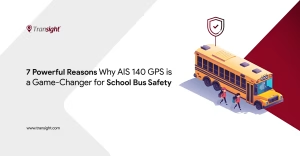
Mrs. Verma sends her children to a school in Kochi via a dedicated school bus. The school currently uses a basic GPS tracking system that allows parents to see the bus’s location on an app. While this offers some peace of mind, it doesn’t address potential issues like speeding in school zones or unauthorized deviations from the designated route.
With Telematics GPS, the school can ensure a much higher level of safety and accountability. The system can monitor the bus’s speed in real-time and send alerts if it exceeds pre-set limits. Geofencing capabilities can create virtual boundaries around the school and designated stops, triggering notifications if the bus deviates from the route. Some advanced telematics systems even integrate with cameras, providing live video feeds for added security and incident analysis. For Mrs. Verma, this translates to knowing not just where the bus is, but also that it’s being driven safely and sticking to the planned route.
Scenario 3: The Efficient Logistics Operator
A transport company manages a fleet of trucks carrying perishable goods across long distances. Maintaining the optimal temperature inside the refrigerated containers is crucial. Mobile phone GPS can only tell them the truck’s location, but it offers no insight into the condition of the cargo.
Telematics GPS, in this case, can be integrated with temperature sensors inside the containers. The system can transmit real-time temperature readings, alerting the fleet manager if there’s a malfunction in the refrigeration unit. This proactive monitoring can prevent spoilage and significant financial losses. Furthermore, telematics can track fuel consumption, temperature, and humidity checks, identify inefficient routes, and even monitor driver fatigue through driving hour logs, leading to significant cost savings and improved operational efficiency.
The Indian Advantage: NavIC and Regulatory Landscape
The Indian scenario presents a unique advantage with the presence of NavIC (Navigation with Indian Constellation). While mobile phone GPS receivers in India increasingly support NavIC alongside the global GPS, telematics solutions can leverage this dual-constellation capability for potentially enhanced accuracy and reliability, especially in areas with signal obstructions. The dual-frequency bands of NavIC can offer better performance in dense urban environments and remote rural areas.
Furthermore, the Indian government’s focus on vehicle safety and security has led to regulations like the AIS-140 standard. This mandate, particularly for public transport vehicles, necessitates features like real-time tracking, emergency buttons, and adherence to specific performance standards – functionalities that are inherently part of robust telematics systems. Compliance with such regulations is a significant driver for the adoption of telematics in India.
Beyond Location: The Power of Data
The fundamental difference between mobile phone GPS and telematics GPS lies in the data they collect and the insights that can be derived from it. Mobile GPS provides a stream of location coordinates. Telematics, on the other hand, generates a rich dataset encompassing location, speed, acceleration, braking patterns, engine diagnostics, fuel consumption, driver behavior, and much more.
This wealth of data can be analyzed to:
- Optimize routes: Identify the most efficient paths, avoiding traffic congestion and reducing travel time.
- Improve driver behavior: Identify risky driving habits and implement targeted training to enhance safety and reduce fuel consumption.
- Predictive maintenance: Detect potential mechanical issues early, allowing for proactive maintenance and minimizing vehicle downtime.
- Enhance security: Implement geofences, receive unauthorized movement alerts, and even remotely immobilize vehicles in case of theft.
- Gain operational efficiency: Monitor vehicle utilization, identify bottlenecks, and optimize resource allocation.
Conclusion: Investing in Insight, Not Just Location
In the complex and dynamic Indian environment, relying solely on mobile GPS for managing vehicles is akin to navigating a dense fog with only a basic compass. Telematics GPS, with its ability to provide real-time, comprehensive data and actionable insights, acts as a sophisticated navigation system, illuminating the path towards greater efficiency, safety, and control.
For businesses in India grappling with the challenges of fleet management, for schools prioritizing the safety of their students, and for individuals seeking enhanced security for their vehicles, the choice between mobile GPS and Telematics GPS is not just about tracking a location; it’s about investing in a solution that provides a deeper understanding of their vehicles’ operations, ultimately leading to better decision-making and greater peace of mind. The initial cost of a telematics system is an investment in preventing losses, optimizing resources, and ensuring a smoother, safer journey on the Indian roads. It’s about moving from simply knowing “where” to truly understanding “what’s happening and how to make it better.”
Footnotes:
- “Finalized Draft AIS-140 regarding Intelligent Transportation Systems (ITS) – Requirements for Public Transport Vehicle Operation.” Ministry of Road Transport & Highways, Government of India, n.d., https://morth.gov.in/finalized-draft-ais-140-regarding-intelligent-transportation-systems-its-requirements-public-0. Accessed 17 July 2025.